
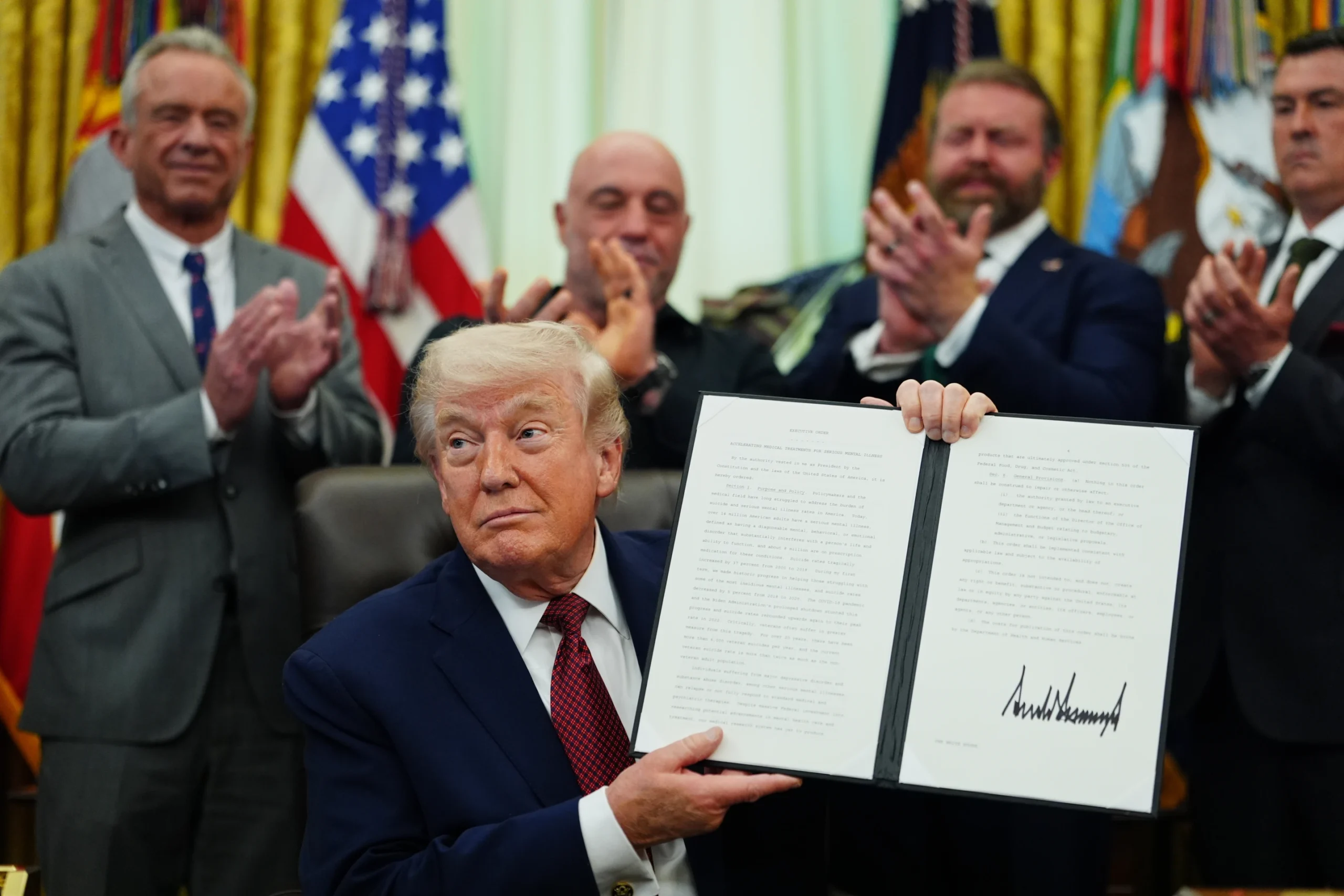
Following President Trump’s April 18 executive order on psychedelic-assisted therapies, ibogaine has received increased attention in national conversations around mental health, addiction, veteran care, research, and medical access.
This does not mean ibogaine has been legalized or approved in the United States. But it does mark a shift in how ibogaine is being discussed at the federal level.
Tom Feegel, CEO of Beond, was recently quoted in the official White House release on the executive order. We covered that in our previous update, where we noted that the order signaled increased institutional attention to ibogaine and psychedelic-assisted therapies. Since then, Beond has also been referenced in media coverage including the Associated Press, PBS NewsHour, CNBC, Military.com, and The Joe Rogan Experience.
This coverage reflects a broadening of the conversation. Ibogaine is increasingly being discussed alongside questions of science, safety, clinical standards, veteran care, and future access — though significant regulatory, safety, and research questions remain open.
From White House Recognition to National Coverage
In our previous post, What Trump’s New Executive Order Means for Ibogaine, we explained that the executive order does not settle the science or create immediate approval. But it does move ibogaine further into formal federal discussion around serious mental illness, addiction, and veteran care.
That remains the key point.
The order calls attention to potential research and review pathways for certain psychedelic therapies, including ibogaine compounds. It also highlights the need for coordination across agencies, support for veterans, expanded access pathways under the Right to Try Act, and further development of credible clinical evidence.
The broader media response reflects growing interest in these questions across policy, research, and clinical communities.
Major outlets are covering ibogaine as part of a national policy conversation involving federal agencies, researchers, veterans, clinicians, advocates, and public figures — alongside ongoing scrutiny of its safety profile and the limitations of current evidence.
Associated Press and PBS NewsHour: Ibogaine Becomes Federally Acknowledged
The Associated Press covered the executive order as part of a broader shift in federal attention toward psychedelics, including ibogaine. The article noted that the immediate impact for ibogaine clinics would not be U.S. approval or insurance coverage — and also highlighted the significance of federal acknowledgment.
As Tom Feegel, CEO of Beond, told the Associated Press:
“There will be no insurance coverage, it will still be considered unapproved and non-covered care. But what it does mean is that ibogaine shifts from being fringe and underground to being federally acknowledged.”
The same AP article was also published by PBS NewsHour.
The executive order does not make ibogaine an approved treatment in the United States. It indicates that federal policymakers are paying more attention to ibogaine as a subject of research and policy review — a meaningful but early step.
Read the coverage:
Associated Press / PBS NewsHour — Trump signs order to speed review of psychedelics
CNBC: The Opportunity Is Execution, Not Hype
CNBC covered the executive order through a broader policy and industry lens, looking at what the psychedelics order could mean for research, clinical trials, Right to Try access, and potential implications for cannabis reform.
In the article, Tom Feegel, CEO of Beond, emphasized that this moment should not be treated as a hype cycle:
“The opportunity now is not hype, it’s execution: rigorous science, disciplined safety standards, physician-led protocols and real-world outcome data.”
That framing reflects where the field actually is. Public and federal attention is growing, but legitimacy will depend on what the evidence shows over time: careful screening, medical supervision, transparent outcomes, responsible protocols, and continued research.
Ibogaine is not a conventional intervention. It carries known risks, including cardiac risks, and remains unapproved in the United States. The next chapter depends on clinical rigor, not momentum alone.
Read the coverage:
CNBC — How Trump’s psychedelics executive order could unlock stalled cannabis reform
Military.com: A Turning Point for Veteran Mental Health
Military.com covered the executive order through the lens of veteran mental health, with a focus on treatment-resistant PTSD, traumatic brain injury, depression, and substance use disorders.
In the article, Tom Feegel, CEO of Beond, described the executive order as:
“a meaningful turning point in how our nation approaches brain health within the military community, particularly for veterans navigating treatment-resistant PTSD, traumatic brain injury, depression, and substance use disorders.”
Veterans, first responders, and families have been among the most vocal advocates for ibogaine research, often after years of seeking relief through conventional care. That lived experience is driving much of the current policy attention.
For Beond, the veteran conversation reinforces what we already hold as foundational: careful screening, medical oversight, and safety-centered protocols are not optional — they are the work, especially for people with complex trauma histories, addiction, and neurological challenges.
Read the coverage:
Military.com — Ibogaine, LSD and Psilocybin: Trump’s New Order a Medical ‘Turning Point’
The Joe Rogan Experience: Public Conversation Turns to Safety and Medical Supervision
The conversation also extended beyond traditional news media.
In a video from The Joe Rogan Experience discussing the executive order and ibogaine, Beond was mentioned as an example of a clinic operating with medical oversight. The video pointed to the importance of ibogaine being administered by qualified clinicians, naming Beond in Mexico and noting the use of cardiac monitoring during treatment.
We want to address some of the statistics that circulated in connection with that coverage — because accuracy matters, especially now.
A Note on the Numbers
At the White House signing, Joe Rogan stated that “one dose of ibogaine has an 80% rate of freeing these people from addiction, and with two doses it’s over 90%.” We understand where that enthusiasm comes from. But those numbers do not accurately represent what the research shows, and we think it’s important to say so clearly.
The 80% figure most likely originates from a 2017 observational study of 88 patients who received ibogaine treatment in Mexico. In that study, 80% of participants reported that ibogaine eliminated or drastically reduced their withdrawal symptoms — a meaningful acute finding. But relief from withdrawal is not the same as long-term freedom from addiction. The same study found that 30% of participants reported never using opioids again after treatment. Across the available literature, one-year opioid cessation rates range from roughly 23% to 55%. That range is worth taking seriously. It does not support claims of a near-certain cure.
The claim that a second dose produces 90%+ freedom from addiction does not appear to be supported by any published research.
The Stanford numbers Rogan cited for veterans — 88% average reduction in PTSD symptoms, 87% in depression, and 81% in anxiety at one month post-treatment — do come from the 2024 Stanford MISTIC study of 30 special operations veterans with TBI. Those figures are accurately cited. They are meaningful. They also come from a small, open-label observational study without a control group — important context for interpreting what they do and do not tell us. More rigorous research is needed before strong conclusions can be drawn.
We raise this not to minimize ibogaine’s potential, but because overstated claims ultimately undermine the credibility this medicine needs to reach the people who may benefit from it. The field is best served by honest data.
What This Coverage Signals
The coverage around the executive order has extended beyond the outlets mentioned above, with additional reporting across Reuters, Newsweek, the San Francisco Chronicle, Fox News, Houston Chronicle, Boston Globe, International Business Times, the White House press briefing, and other national and regional platforms.
This wider media response points to the same larger shift: ibogaine is now being discussed in mainstream policy, medical, veteran, and public health contexts.
For years, ibogaine has occupied a complicated space — drawing genuine interest from veterans, researchers, families, and people seeking options after conventional treatments fell short, while remaining unapproved in the United States, carrying known medical risks, and requiring serious clinical oversight.
This moment does not resolve those complexities. It does not mean legalization, immediate FDA approval, or the removal of the clinical and safety standards that responsible ibogaine treatment requires.
What it does mean is that more people — policymakers, clinicians, researchers, journalists, and the public — are asking questions about ibogaine that deserve careful, evidence-based answers. The work ahead is to make sure this attention translates into rigorous research, honest reporting, and clinical standards that protect patients.
As Tom Feegel, CEO of Beond, put it:
“The opportunity now is not hype, it’s execution: rigorous science, disciplined safety
standards, physician-led protocols and real-world outcome data.”